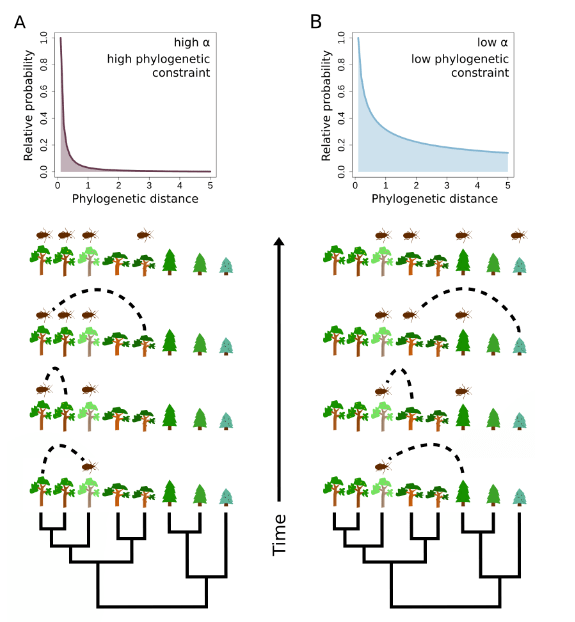
I think this is a really exciting paper as it reconceptualises evolutionary conservatism as a process that can shape ecological patterns across the tips of a phylogeny (here, the distribution of insect pests on forest trees) versus our more traditional model of evolution along the branches of the phylogeny. Here, we liken the movement of pests between hosts to a Levy flight process, with many jumps between closely related hosts and occasional long jumps to phylogenetically distant hosts. Published in Proc R Soc B: Pest host expansion as a scale-free stepwise process across the host phylogeny. Perhaps we could have come up with a more engaging title? Co-incidentally, it was pointed out to us by Will Pearse that our index of phylogenetic conservatism also allows us to capture ‘anti-signal’. This seems useful, but I am not exactly sure what for.