Phylogeny & Climate Change
Plants and animals are responding to climate warming in various ways, and average responses have been well-documented in the literature. However, in a large meta-analysis, we suggest that predicted ecosystem changes—including continuing advances at the start of spring across much of the globe—may be far greater than current estimates based on data from experiments and that individual species’ responses are highly variable (Wolkovich et al. 2012 Nature 485:494). These findings question our ability to accurately predict species responses to future change.
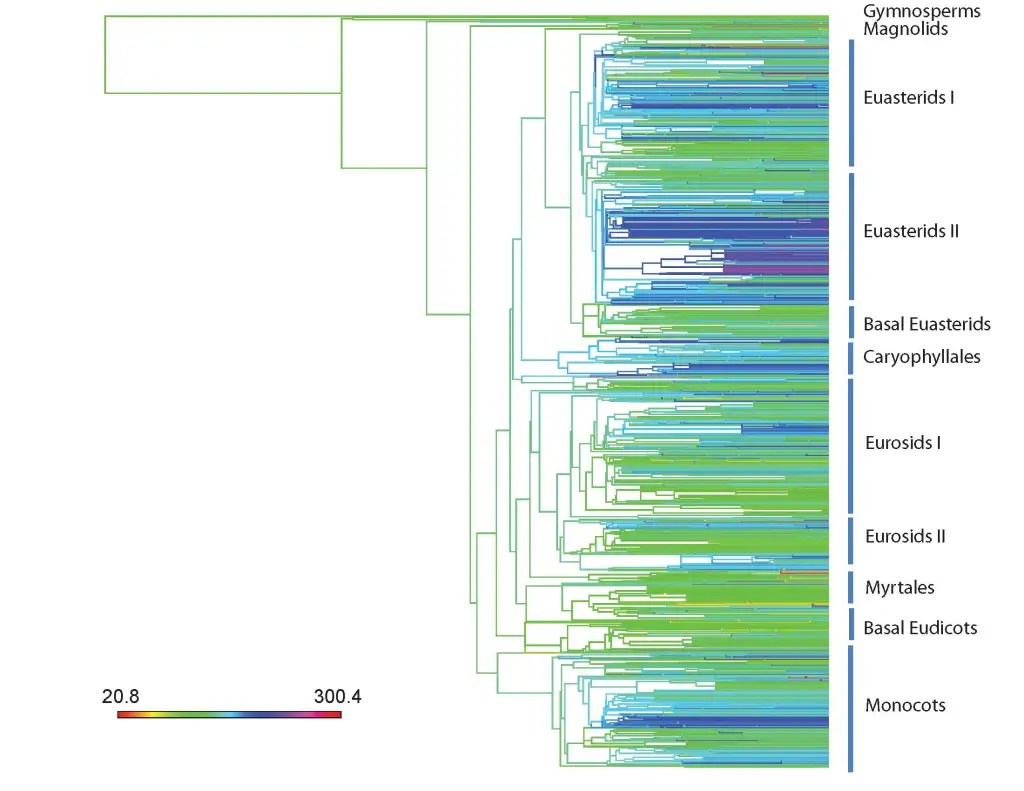
Over the past decade, we have developed increasingly sophisticated models that have allowed us to predict extinction risk in various taxonomic groups (see above). We currently lack equivalent robust models for predicting responses to climate change. Phylogeny provides one avenue forward. For example, because phenology is evolutionarily conserved (Davies et al. 2013 J Ecol 101:1520), it might be possible to estimate species sensitivities from taxonomic membership (Mazer et al. 2013 Am J Bot 100: 1). It is also possible to use phylogenetic methods to identify key traits and environmental cues triggering flowering (Lessard-Therrien, Bolmgren & Davies 2014 Botany 92:749; Lessard-Therrien, Davies & Bolmgren 2014 Int J Biometeor 58:455), to help better understand interspecific variation in species’ responses.
Several key review papers synthesize our current knowledge but also identify important knowledge gaps (Wolkovich et al. Ecol Lett 2014 17:1365; Wolkovich, Cook & Davies 2013 New Phytol 201:1156; Pau et al. 2011 Global Change Biol 17:3633).
This research has been widely reported in the media and informed the Fifth Assessment Report from Working Group II of the IPCC.

